Health check
Review configuration, performance, backups and security.
WHAT YOU RECEIVE
health-check report, prioritised fixes

Microsoft SQL Server and Azure SQL
Design, tune, secure and migrate the databases your applications depend on.
SQL Server is Microsoft's relational database, and Azure SQL is its family of managed cloud versions. We design schemas, tune performance, set up high availability and security, and migrate databases from older SQL Server versions to supported platforms on-premises or in Azure.
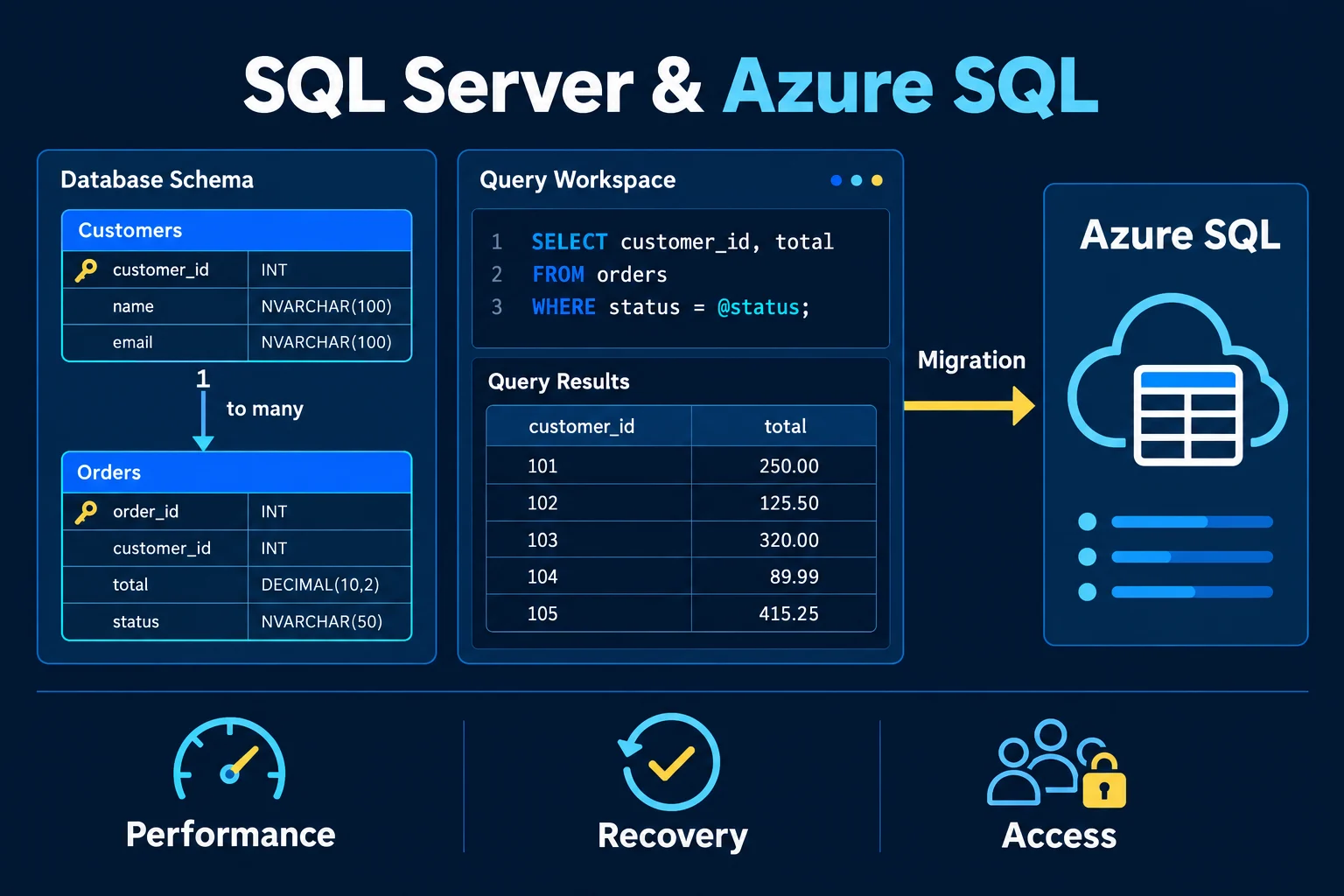
Platform overview
Microsoft SQL Server is a relational database engine used by a large share of business applications, especially those built on .NET. It runs on Windows and Linux, and recent versions add features such as intelligent query processing, ledger tables and, in SQL Server 2025, built-in vector search for AI applications.
Azure SQL covers three managed options: Azure SQL Database, a fully managed database service; Azure SQL Managed Instance, which keeps near-complete SQL Server compatibility including SQL Agent and cross-database queries; and SQL Server on Azure Virtual Machines for full control. Choosing between them depends on compatibility needs, administration effort and cost. SQL Server 2016 reached the end of extended support in July 2026, so many organisations are planning upgrades now.
Engagement scope
What we deliver
Each piece of work has a clear output, so you know what you will receive.
Review configuration, performance, backups and security.
health-check report, prioritised fixes
Analyse Query Store and wait statistics and fix the causes.
tuning changes, before-and-after measures
Assess compatibility and migrate with tested cut-over.
migration plan, runbook, migrated databases
Availability groups, geo-replication and recovery testing.
HA/DR design, recovery test results
Schemas, indexing strategy and data migration for new systems.
data model, migration scripts
Least-privilege access, encryption and auditing.
security baseline, audit configuration
Practical applications
Typical database work for application and data teams.
Find and fix slow queries, blocking and missing indexes.
Move off unsupported SQL Server versions safely.
Move to Azure SQL Database, Managed Instance or Azure VMs.
Always On availability groups and failover planning.
Data models for new applications and integrations.
Permissions, encryption, auditing and data masking.
Read replicas and models for reporting workloads.
Backups, index maintenance and health checks.
Platform & integration
Options we choose between for each workload.
Listing a feature here does not mean every project uses it. We recommend what fits your requirements, skills, licensing and running costs.
SQL Server is the usual data store for .NET applications and runs on-premises, on Azure and on AWS through Amazon RDS. Analytics teams bring its data into Microsoft Fabric through mirroring or pipelines, and report on it with Power BI.
Data movement between SQL Server and other systems often runs in Azure Data Factory. For dedicated specialists, see Hire Data Architects.
Designed for real operations
Check application compatibility and deprecated features before upgrading.
Choose the Azure SQL option by compatibility needs first, then cost.
Test performance after migration; plans can change between versions.
Use Query Store before and after changes to measure the effect.
Test restores and failovers regularly, not only backups.
Review licensing, including Azure Hybrid Benefit where it applies.
Delivery approach
Goals, users, constraints and the systems SQL Server and Azure SQL must work with.
Agreed goals, constraints and success criteria
Confirm SQL Server and Azure SQL is the right fit and agree the architecture and scope.
Reviewed architecture and delivery scope
Deliver in short iterations with testing, reviews and documentation.
Tested solution with implementation documentation
Monitor, support and improve the solution as your needs change.
Handover, monitoring and an improvement plan
Common questions
Azure SQL Database is a fully managed single database or pool. Managed Instance keeps near-complete SQL Server compatibility, such as SQL Agent and cross-database queries.
Standard extended support ended in July 2026. Extended Security Updates are listed separately in Microsoft’s lifecycle policy. We assess upgrade or migration options and any applicable ESU entitlement.
Yes. We analyse queries, indexes, waits and configuration and fix the root causes.
By assessing compatibility, rehearsing the migration and using replication or online migration methods where possible.
SQL Server 2025 and Azure SQL offer vector capabilities for AI retrieval scenarios. Available functions, limitations and deployment support must be checked for your version and service.
Yes, though this page focuses on Microsoft SQL Server and Azure SQL.
Let’s plan your next step
Tell us about your SQL Server versions, workloads and goals, and we will suggest next steps.